COMPARISON: And The Unfair Advantage…

When we compare ourselves to others, we make the mistake of believing that we are just like everyone else. When we compare our situation to the next person’s, we do ourselves a disservice in believing that our journeys’ are the same. In the same way that Jesus never performed two miracles the same, no two people are the same and we are not all on the same journey.

The worst thing we can do, is compare our situation to the next person’s. Just because we believe something to be fact, does not qualify our fears. And therefore, just because someone we know got dismissed, does not mean we will be next. And just because someone we know did not receive their miracle, does not mean the same will happen to us. We must have the mindset to know and believe that we are different, because we are different. God created us uniquely, each with our own set of fingerprints and DNA that cannot match that of anyone else’s.

While we may exhibit similar features and traits, even as twins, God created us to be different. Your nexus with God, within the parameters of your relinquished power to Him, dictates your future. You are different because God calls to you, and promises if you return that call, to give you wealth that you never dreamed of. “I will give you hidden treasures, riches stored in secret places, so that you may know that I am the LORD, the God of Israel, who summons you by name” (Isaiah 45:3).

He also said that He will give you unfair and unmerited favour because of your relationship with Him, and by that, He will take from your enemies to give to you. “…I will extend peace to you like a river, and the wealth of nations like a flooding stream…” (Isaiah 66:12; Isaiah 60:5).

So when others are being struck down and dismissed, the blood covenant between Jesus and your heart (made by you surrendering your heart to Him), just as God’s blood covenant with the Israelites that protected and left them unharmed on account of the blood on their doorframes (Exodus 12:23 and 36), will ensure that you remain unharmed. When it is not coming to pass, not working out, and drying up for others, it will come to pass and overflow in your territory, “the blessing of the Lord brings wealth, without painful toil for it” (Proverbs 10:22). And when chaos hunts them down, peace will be summoned to shield you, “for a thousand may fall at your side, ten thousand at your right hand, but it will not come near you” (Psalms 91:7).

But should it happen that a door that you thought ought to have remained opened, closes, remember that when God is Lord over your life, only He allows the doors to close. And in the event that a door should close, then He allowed it because He has better in store for you, “… I have opened a door for you that no one can close” (Revelations 3:8; Isaiah 22:22).

If you believe this, then no harm will come to you. But if you believe you are like everyone else, then the same fate that befalls them, will befall you. Put another way, if you believe that your blessings come from man, then man has the power to take them away. But if you believe that your blessings come from God, then no man can take them away unless God wills it, “For the LORD Almighty has purposed, and who can thwart Him? His hand is stretched out, and who can turn it back?” (Isaiah 14:27).

It is all about a shift in perspective. Do not give power to the wrong energy. Grant power to God, and in turn, He will ensure that your destiny is one that will be favourably disposed. A destiny that will transition from ordinary to superordinary, from mediocre to unmerited favour.

©Katie Mliswa and MomentsbyKatie.M, 2018.
FEELINGS: What Is In a Feeling…

We all have days in which we are confident in ourselves and our abilities. Days in which we toot our own horn and feel invincible. And then come the other days. The days when we cannot even scrape together a positive attribute to express of ourselves.

On some days, confident like Elijah, we sit on our mountain top and summon our enemies in great numbers in order to witness the strength that is within us (1 Kings 18:19). On these days, we compete not against the weak, but like Elijah, call only for competition with the very best (1 Kings 18:19).

Elijah not only provoked his opponents when he was one against eight hundred and fifty, but in the end, he had all eight hundred and fifty killed (1 Kings 18:27-28; 40). And Elijah’s strength did not stop there! He also prayed and caused fire to burn and consume wood that was immersed in water (1 Kings 18:38). However, of the 850 killed, 400 were the prophets of Asherah who eat at Jezebel’s table and resulted in Jezebel’s vengeance (1 Kings 19: 1-2). The very next day, after facing but a mere threat from one woman, Jezebel, for the killing her prophets, Elijah took her threat to heart, let it consume him, and ran. Even going so far as to ask God to take his life (1 Kings 19:4).

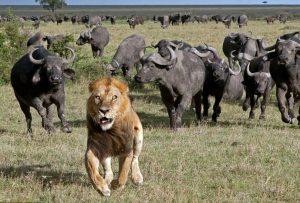
So what is it that caused the mighty man Elijah to waiver from roaring and boasting in the Lord’s confidence, to whimpering away like a mighty lion running from away from its prey?

Elijah let his feelings of the fear of the threat define his standing and cloud his judgement as to what power he truly possessed. Like Elijah, just because we think, feel or fear something, does not make it true. The enemy’s ploy, like Jezebel, is to instil fear in us to the point that we drown out God’s voice and allow the voice of the enemy and his lies to increase. The enemy’s ploy is to have us forget who we are and what we have achieved, and instead focus on the negative, allowing it to eat at us until we can no longer remember the identity and power we possess within.

By the time the enemy was done with Elijah, Elijah remembered not who he had been, nor the power he had in his corner, and the great miracle of yesterday had been all but erased from his thoughts.

Like Elijah, we cannot let our thoughts, our fears, nor our feelings dictate the ending of our setbacks of today. Those perceived setbacks are but in fact our set up for our future come up of tomorrow. Just because we feel or think a certain way does not mean that we should run with those thoughts and feelings. Negative thoughts and feelings which do not line up with what God says of us should be drowned out immediately with the Word of God. When negative thoughts and feelings creep in, we must remember that the opposite is true and speak out that truth to muzzle the lies of the enemy:

I feel like a failure – I am not a failure. I am more than a conqueror through Christ Jesus (Romans 8:35 –39). Though I may have fallen seven times, yet will I rise again (Proverbs 24:16). I can do all things through Christ who strengthens me (Philippians 4:13).
I feel so stupid – I am not stupid. I am fearfully and wonderfully made, and made in the very image of God with His likeness and intelligence (Psalms 139:14; Genesis 1:27).
I feel so lost – Jesus take the wheel, I cast all burdens to You (Psalms 55:22).
I feel so broken – God put me together and make me strong (Psalm 147:3; Joel 3:10).

The Word of God will tell you who you are. And who you are is a warrior! You are not the prey and therefore your thoughts and feelings should not dictate your identity. Just because you feel or think a certain way does not make it true. In the same way that you might feel like a Ferrari but that feeling will not make you a car, we are more than the sum of our feelings. We possess within us the same power that raised Jesus from the dead. This is the truth we must hold to in our times of doubt and fear.

We can feel and think a lot of things, but the only thing that matters and holds true are the feelings and thoughts that line up with what God says about us as his children and friends.

©Katie Mliswa and MomentsbyKatie.M, 2018.

DISAPPOINTMENT: In The Wrong Place at …

The one who found themself in the wrong place at the wrong time knew that they should not have been there, and would never have been there, but for the disappointment in their life. The disappointment clouded their judgement and drove them to the place in which they should never have been. And now in that place, they stand in the line of fire. But are they truly in the wrong place at the wrong time? Is there such a thing as being in the wrong place at the wrong time?

In the spring time, at the time when kings go off to war – King David remained in Jerusalem (2 Samuel 11:1) Four chapters earlier, God had promised to establish David’s house and give him rest from his enemies. At this stage David was already married, with at least four wives, Michal, Ahinoam, Abigal, and Maacah. Three chapters in from the promise, David sought to send his condolences to Hanun for the passing of his father the King of the Ammonites. Unfortunately, David’s kind gesture was not received well and instead resulted in a battle between David against the Ammonites and the Aramean’s.

Entering into chapter 11, in the battle against the Ammonites and the Aramean’s, the Aramean’s withdrew and David was left to battle against the Ammonites only. But instead of going off to fight for his country and finish off the enemy, David remained in Jerusalem. When David remained in the place in which he should never have been, he met Bathsheba and consequently committed adultery. Bathsheba became pregnant, which culminated in events in which David became a murderer when he ordered the death of Bathsheba’s husband. How did David end up at this point? Of committing adultery and ordering the death of another? I believe David found himself in that situation because of disappointment. David may have felt disappointed that God promised to give him rest from all his enemies (2 Samuel 7:11), but instead, out of a gesture of kindness, David now faced a battle which in his eyes should never have been.

If this is the case, then I believe that David’s disappointment was rooted in a great misinterpretation of what God meant by “giving him rest from his enemies”. I believe that what was promised to David in his lifetime referred to “rest” as the assurance of victory in every battle he faced. Prior to the promise of rest, the Israelites had been oppressed and defeated in every battle (2 Samuel 7:10), but immediately after the promise, (chapter 8), the Israelites had nothing but victory against their enemies.

While the disappointment may have led David to a place where he appeared to be in the wrong place at the wrong time, the place that should have been the wrong place turned out to be the right place, because after David repented, it was through his marriage to Bathsheba that they birthed King Solomon, who was known to be the wisest man to have ever lived. Furthermore, what is most fascinating, is that David had at least four other wives before Bathsheba with whom he had children, yet none of those children went on to play such an important role as Solomon. And not only did God fulfil his promise for complete rest from his enemies through the King Solomon era, God also fulfilled his promise to establish a house for David forever, for it is through the David and Solomon lineage that Jesus came!

So, if we embrace this new perspective, is there such a thing as being in the wrong place at the wrong time? If it is indeed true that God directs our footsteps, when we give Him the reins of our lives, then there is no such thing as coincidences or being in the wrong place at the wrong time. While it may be true, like David, that at times we walk in a path that displeases God and leads to the wrong place, God in His omniscience omnipresence, and omnipotence, knows about the wrong path before we take it. He goes ahead of our path and turns it around for our good so that that wrong place that could have had devastative consequences, becomes the wrong place at the right time to work for our good!

Although we may not be able to understand the ways in which God works if we allow God to harness the mess which we have made of our lives by giving ourselves over to Him in faith, our disappointing situations will transition from the wrong place at the wrong time, to the wrong place at the right time.

©Katie Mliswa and MomentsbyKatie.M, 2018.

HEART STRINGS I: The war of words…

The severed heartstrings, which once joined souls together, now lie detached and motionless with no more force to tie the two together. Choose your battles wisely, they say, for not every battle is worth fighting. As true as the saying is, on the other side of it is also the fact that if you are still fighting, then you are probably still loving.

Sometimes the danger is when there is no more fight left and no more words to say. Being designed innately different in our characteristics and personalities, it is inevitable that every now and again we would clash in our world point of views and personalities. When the emotions are invested, they tug at the heartstrings and demand a reaction – be it of love or of anger. And should the feelings of anger be aroused, this can culminate in a fight. Not a physical or abusive fight, but a fight in the quintessence of the soul’s strings, fighting to remain attached and fighting for the relationship.

When the strings are connected, and one still cares, you talk about it. But when the strings are severed, and the emotions become disengaged, the line of communication is broken. The day to be weary is the day when the emotions fail to tug the heartstrings. For when this day comes, the one with the severed strings, too tired to fight, will flee just as Jonah tried to flee from the Lord (Jonah 1). Jonah is a man in the Old Testament who once was passionate to see the destruction of Nineveh.

As displaced as his passion was, when he cared for this unrighteous outcome, he talked and argued with God about this (Jonah 4). But when the day came when he could no longer be concerned for the Nineveh’s outcome, and his emotions failed to tug his heartstrings – the day when he stopped caring – he ran away from God’s will (Jonah 1; Jonah 4:1–2).

The healing power of communication should never be underestimated, for issues unresolved leave holes and wounds unmended. Healthy relationships are built on the ability to talk about issues. But when communicating, as James 1:19 says, we must be quick to listen, slow to speak, and slow to get angry.

Where is there passion, emotions are bound to arise. Even Jesus had righteous anger (Mark 11:15). But in the heat of the moment the one who wins the fight, even in losing the war of words, is the one who fights fair without going for the jugular, for this one never has to live with the haunted mind of the words that can never be taken back.

©Katie Mliswa and MomentsbyKatie.M, 2018.

ANXIETY: And the chaos of tomorrow…

At some point in our lives, we may have heard the phrase, ‘Rome wasn’t built in a day’, and yet many of us we try to master our future in one day. With haste and no precision, we take a thousand steps into our future and then find ourselves unnerved by the vastness of the dream.

It is true, that only a fool brags about not planning ahead (Proverbs 13:16), but we also need to be wise enough to understand the right time to slow down and take a thousand steps back, if necessary, in order to re-calibrate our focus.

There’s a reason why God does not show us our entire journey to the mountain top. He knows that if He showed us the entire journey, we would either purposely or subconsciously speak or take actions against the steps which we are required to take to get to where we are meant to be. Just like Joseph, God knows that if He had shown him what he would face before becoming governor, Joseph would have talked himself out of following the dream – being anxious over the horror of the pit, the humiliation in slavery, the accusations in the palace, and the pain and loneliness of the prison cell, before the arrival to the throne (Genesis 37; 39–48).

To protect us, God only shows us a glimpse of what is yet to come — that one day we will be triumphant as the head and not the tail; with the sun, moon and stars bowing before us (Deuteronomy 28:13; Genesis 37).

God will get us to where we need to be and only asks that we trust in His plans for us. There will be times when we will be required to march on covering vast ground, and other times when the wisest thing to do, will be to retreat and focus on surviving today’s battle alone. There will be times to set goals and envision the future, and other times to sit back and take each day as it comes.

When the time comes to take a thousand steps back and focus on ‘today’ alone, rest in the Word and in knowing that Jesus has already gone into your future to establish the peace which you will experience in the chaos of tomorrow. And when the chaos of tomorrow tries to steal your peace of today, remember the encouragement from Jesus, “…do not worry about tomorrow, for tomorrow will worry about itself. Each day has enough trouble of its own” (Matthew 6:34). The emphasis is not that we should not plan for tomorrow, but that we should not be anxious about things that are not in our control, for worrying about them will not add a single hour to our lives (Matthew 6:27). But instead, we should cast our anxieties and burdens to Him who has control over them (Psalm 55:22; Matthew 11:28-29; Philippians 4:6-7).

©Katie Mliswa and MomentsbyKatie.M, 2018.

SILENCE: And the vision board of dreams…

We all have a dream. Some even place the dream on a vision board. And every day, we wake up to work on the dream and fight to keep it alive despite the perpetual voices of doubt and whispers of discouragement from ‘them’ and the many detours on the way.

But the greatest obstacle to our dream, is us. Regardless of how we fight ‘them’ to keep the dream alive, if we can’t fight ‘us’ then we sabotage and destroy our own dream. The dream can never be kept alive if the mind and the tongue are not in unity with the dream.

We can place the dream on our vision board, but if we fail to control the negative voices within, and worse still, if we allow those negative voices to speak, then we dredge a grave for the dream. The wise words in the Book of Proverbs say, “[B]e careful what you think, because your thoughts run your life” (Proverbs 4:23), and Proverbs 18:20–21 says, “From the fruit of their mouth a person’s stomach is filled; with the harvest of their lips they are satisfied. The tongue has the power of life and death, and those who love it will eat its fruit.”

Because the tongue is as lethal as the mind, God took the drastic step of silencing the tongue of one man until his dream came to pass. That man was Zechariah. For many years, he fervently prayed for his dream. He had his vision board and every day he would do what he could and then ask God to do the rest. One day while he was in prayer fighting for his dream, God sent an angel to tell him that his prayer had been heard and he would receive that which he asked for. One would think that such news would have been received with great elation, but instead, Zechariah stood startled by all this and questioned how he could receive that which he asked for, given that he and his wife were both advanced in years (Luke 1:5–14).

Too many of us have dreams which if we were honest with ourselves, we would find that we really do not believe that the dreams will ever come true. The dreams remain a good idea on the vision board to make us feel better for ‘at least’ having a goal which we really do not believe can be achieved but nonetheless is there for all to see, that ‘at least’ we have a dream.

But God does not want us to be an ‘at least’ people. The dreams come from Him, and because He gives the dream to us, He promises to work on the dream with us until it becomes a reality (Philippians 1:6). And sometimes, in order to refrain us from sabotaging our dreams, He might silence us as He did with Zechariah until the fulfilment of the dream (Luke 1:20). The silence might be that uncomfortable place where you have no one and nothing to turn to, but God. But know that even in the silence, God is working with you on your dream and at the appointed time, it will come to pass.

©Katie Mliswa and MomentsbyKatie.M, 2018.

2018: The year to be more…

The fresh aroma of the New Year inspires endless possibilities to be more than we were last year, to conceive that which was never dreamed / possible, and to go where our limitations barred us. Last year, we may never have dreamed, like David, that we could be more than the dust on our feet. And yet overnight, at the dawn of the new day, David went from a shepherd boy tending to sheep in the field, to a future king of a great nation (1 Samuel 16).

The woes or victories of last year do not determine the outcome for this year. The re-set of the New Year offers a clean slate to rewrite this year’s ending, but the choice to re-set our minds and rewrite the ending, remains ours.

We can choose to advance with the configurations of the year that was because they worked and the year was filled with victory. But the example of the mighty Samson should stand as a reminder that we should never be so comfortable as to live only in yesterday’s glory and fail to plan for tomorrow’s battle (Judges 16).

Conversely, the year that was may have been painful and bitter, and we can still choose to proceed with the same configurations, lamenting and calling ourselves Mara (the one whose life is bitter) (Ruth 1:20–21). But if you are sick and tired, of being sick and tired, you can give the reins of your life to Jesus so that He can be a new force, turning your mourning into joy, and remind of you of His promises—that despite your location, your name and destiny never changed in his book, and a bright future awaits you.

For those who were victorious last year, allow God to direct your footsteps and He will raise you higher than you could ever dream for yourself: for “no eye has seen, no ear has heard, and no human mind has conceived the things God has prepared for those who love Him  (1 Corinthians 2:9).

©Katie Mliswa and MomentsbyKatie.M, 2018.

WHAT IF: The plague that starved the coward…

There was once a man who had a thousand reasons to pursue his goals, and a thousand not to pursue them—but in the end, he chose not to, and lived with the plague of “what if.”

The melody in his head of “what if” crippled him to do nothing throughout his life, and left him haunted with the question – the question that now could never be answered. His life was a clock that could never be unwound.

What if – the cousin of “should have, could have, and would have”—the terrorist family of doubt, specialising in using fear as a weapon, and causing the Stockholm syndrome in which the act of avoiding is irrationally justified to be better than the act of doing. In reality, the weapon (f.e.a.r) in its true sense is merely “False Evidence Appearing Real.”

The “what if” plague has existed since the days of old and brought destruction to the Israelite grumblers and doubters (Numbers 13 & 14). The Israelites were promised the land flowing with milk and honey, but to get to the land, they had to explore the land and defeat its inhabitants.

Twelve spies were sent to explore the land, and out of the twelve, ten spies, despite knowing that God was on their side, chose to see themselves before the opposition as nothing more than tiny grasshoppers and, irrationally concluded that the opposition were giants. They told themselves that the conquest would be impossible, and gave up.  But the two remaining spies, Caleb and Joshua, saw themselves as the giants and the opposition as grasshoppers because they knew that they had the greatest weapon on their side, God (1 John 4: 4 says, “You, dear children, are from God and have overcome them, because greater is He who is in you, than he that is in the world”).  Caleb and Joshua would not listen or agree with the negative report, so when the ten spies said it was impossible, Caleb silenced them from delivering the negative report (Numbers 4:30). In their eyes, the report was merely the opinion of the ten spies, and that opinion was not a fact.

The question “what if” will always rear its ugly head – “What if I try and fail?” But the same can also be asked in the positive, “What if I try and succeed? What if the glass is half full and what if the glass is half empty?” Seeing the glass as half full divides the leaders from the followers. To live with the plague of “what if” is like the lion that saw itself as a grasshopper and dared not to explore the jungle for his meal. Like the Israelites, we must overcome before we can achieve. Our adversities may seem like giants from afar, but if we get close enough, we will find that our biggest hurdle was only grasshopper.  Silence the negative “what if” and you will silence fear in your life. In the long run, the ones that live “Oh well, I tried” lives, are those who have no regrets. They learn and grow from their experiences to become better people for it. The coward that lives plagued and haunted with memories of “what if” will always be left the same as when they started, or worse.

As William Shakespeare said in Julius Caesar, “A coward dies a thousand times before his death, but the valiant taste of death but once …”

©Katie Mliswa and MomentsbyKatie.M, 2017.